About posterity
5'

I caught myself thinking about a friend's film, and a very specific line from it.
It's a shortfilm about the passing of his sister. The film itself has become the expression of his grieving process. It alternates between footage he shot upon his arrival in Montreal on Super 16, his personal family archive, and some whatsapp audios he saved from his exchanges with his sister. A very touching formulation that works with the evocation of absence: the film opens on railroad tracks, over which we hear a train passing without ever seeing it. A ghostly aspect of sound; either as an echo of a past reappearing like a ressurgence, or as a total rupture between sound and image - one is left broken after such a traumatic event - or this separation might seem like a friction between the sensible world (the one we see) and the world of the mind full of expectation, thoughts or remembrances (the one we hear) that are not tangible but continue to echo in the mind. The film is structured around this formal disruptivity (with the exception of the archival footage on tape, which is elegantly preserved in its entirety in the montage, as little diamonds of memory).
At one point in the shortfilm, my friend and his sister are on a ferris wheel. It's one of those archival clips taking straight from their home video tapes. They were teenagers - or almost adults - at the time. He asks her jokingly:
What do you have to say for posterity ? (...) Everything is for posterity.
In a way he was right. That moment has been preserved for posterity in this shortfilm. But to this question his sister didn't say anything, or at least didn't answered really. As if this question didn't concern her: they're on a ferris wheel enjoying the moment and their vacation, it's not the moment for that.
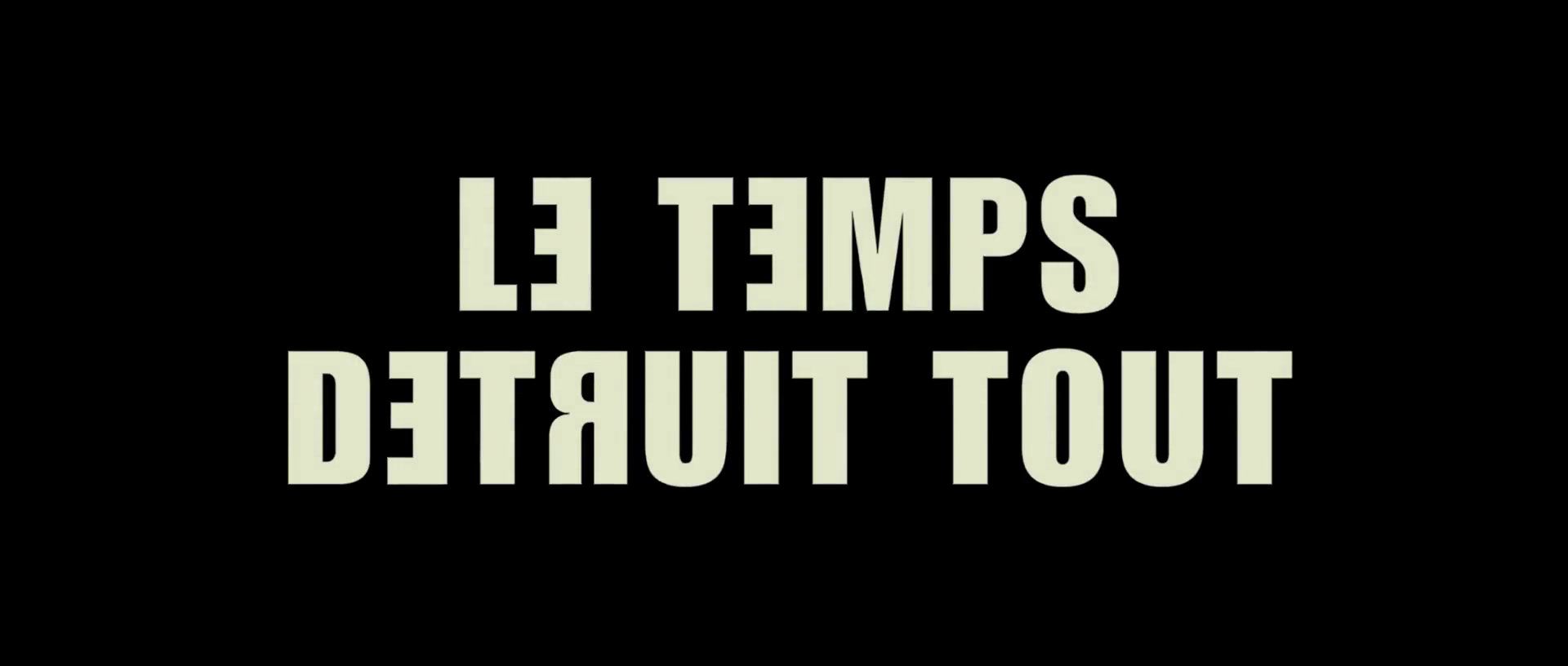
This led me to reflect on this aspect of posterity: some persons have the desperate need to achieve things for posterity, becoming the center of their life and the fuel for their actions. But. Why ? Perhaps it's my own pessimistic view of life. "Time destroys everything"1. To live for posterity is personnaly futile and a lost cause. It seems rather a battle for one's own ego. Even if it disguises itself sometimes like a battle for one's family or close relatives. E.g. I'm doing this to make my parents or my children proud. From what I understand, posterity represents something more than pride - something that will preserve your memory beyond your own time in some grandiose gesture. Though I'm sure, we'll survive mostly through the ones we brought happiness to.
The opposite view - strangely - brought me to the same conclusion. If one is an optimist, one wouldn't think much about posterity. From the epicurean perspective: Carpe Diem meaning "pluck the day as it is ripe". I believe the optimist wouldn't care much about posterity, as that would amount to worrying about a made-up problem for something that transcends our own mortality. Maybe I'm drawing a shortcut between epicureanism and optimism, but I find it hard to imagine an optimist stressing about their own posterity. They'd think the problem will resolve itself, or that their actions alone will be enough to ensure their posterity...
Anyway. All things considered, the problem of posterity doesn't belong to the pessimist or the optimist.
I think my friend was neither, but rather a sentimentalist. In the sense that he's thinking as an artist. While his sister seemed to be the optimist, focusing on the present moment. Which weighs heavily emotionnaly in this personnal tragedy.
In fine, even if I was thinking here in absolute terms (pessimism or optimism), I obviously doubt anyone lives in either extremity. And to make sure, I'm not that pessimistic - well, sometimes. Or maybe I'm just a realist.
The end quote from the infamous Irréversible (2002) (LE TEMPS DÉTRUIT TOUT / TIME DESTROYS EVERYTHING). A fatalist Memento Mori. It's a direct and unsubtle statement that elucidates (or at least gives some motives for) the formal aspect of the film - especially why the films unfolds in reverse chronological order - and the extreme violence of the film.↩